Automotive Test Chambers
Environmental Test Chambers for the Automotive Industry
Ensure your vehicle components meet the highest standards of performance.
Ensuring vehicles meet stringent safety and reliability standards is a top priority for both automobile manufacturers and car parts manufacturers. AES automotive test chambers play a crucial role in this process by subjecting vehicles and components to rigorous testing in extreme conditions. From assessing quality and durability to verifying adherence to lifespan warranties, these chambers are indispensable tools in the automotive industry.
Automotive environmental testing becomes even more critical for hybrid and electric vehicles reliant on lithium-ion batteries due to the batteries' sensitivity to factors like humidity. Our battery safety chambers and battery testing solutions are optimized to be able to help automotive manufacturers continue to test their products to be the best they can be.
Environmental Test Chambers are essential for testing individual automotive components like control electronics, sensors, and restraint systems, and for conducting full vehicle testing in walk-in rooms large enough to drive into. With our extensive experience and commitment to innovation, AES remains the industry leader for automotive companies seeking reliable and cutting-edge testing solutions to meet the demands of the competitive market.
Test Chambers for Automotive: Talk to an Expert
Fill out the form, and you’ll soon be in touch with a test chamber expert.
What Conditions Can Automotive Test Chambers Simulate?
Automotive test chambers reproduce the temperature, humidity, and corrosive conditions a vehicle meets over its service life, just in a test that runs in days rather than years. Where a part sits on the vehicle usually tells you which of those conditions you need to reproduce.
-
Extreme temperature: A chamber holds a setpoint long enough for the part to soak through rather than warm up on the surface. That is where you can identify drift in sensors and control electronics.
-
Temperature cycling: Repeated heating and cooling works fasteners loose and fatigues seals. Failures that never appear during a single soak show up after a few hundred cycles.
-
Humidity conditions: Moisture can quickly turn a marginal seal into a warranty claim. Lithium-ion cells are sensitive enough thathumidity control matters as much as temperature on battery work.
-
Corrosion: Salt spray reproduces years of road salt and coastal air in weeks. It is the standard screen for coatings and exposed underbody hardware.
Most automotive testing is done on individual parts. A vehicle test chamber sized as a walk-in room extends the same conditions to a fully assembled vehicle.
Battery Testing for Electric Vehicles
Electric Vehicle (EV) Manufacturers rely on battery test chambers to simulate the extreme climates that EVs will often encounter on the road. Patented for a system for the high-density testing of batteries within an environmental test chamber, AES offers patented and patent-pending battery testing solutions that are equipped to grow alongside the fast-paced battery testing industries. We custom-tailor these fixtures specifically to your battery testing needs. Rest assured that AES is your innovation ally throughout your process and we are ready for the challenges of the road ahead.

High Capacity Battery Testing
ATPHEAVY ADAPTABLE
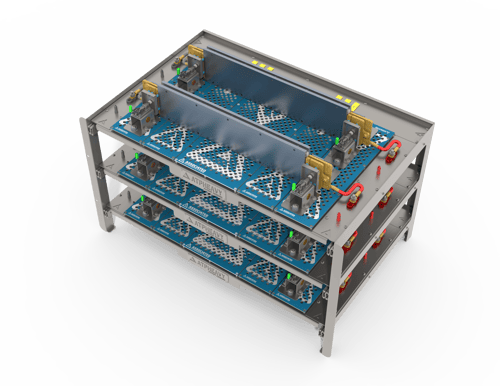
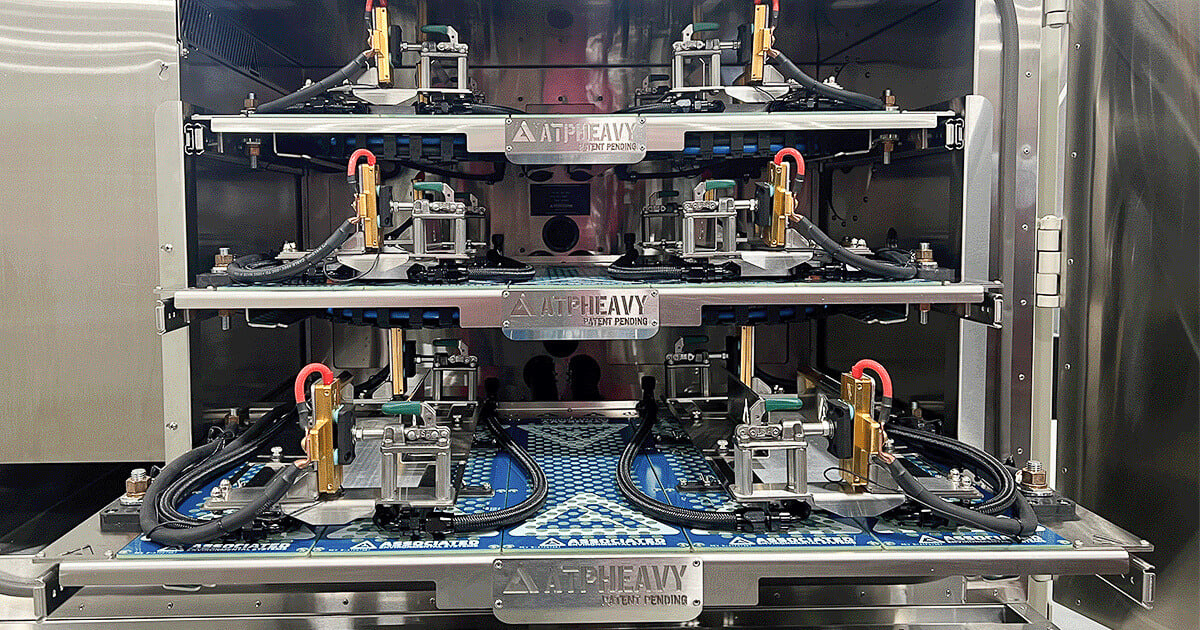
The patent-pending ATPHEAVY ADAPTABLE is designed to accommodate larger capacity and higher current cells. The test surface allows for a modular design with interchangeable plates to support different cell sizes and current requirements of pouch, prismatic, and cylindrical cells. This solution will be custom molded to your cells, and be versatile incase of future shifts.
Integrated Battery Testing System
BATTERY TEST CHAMBER
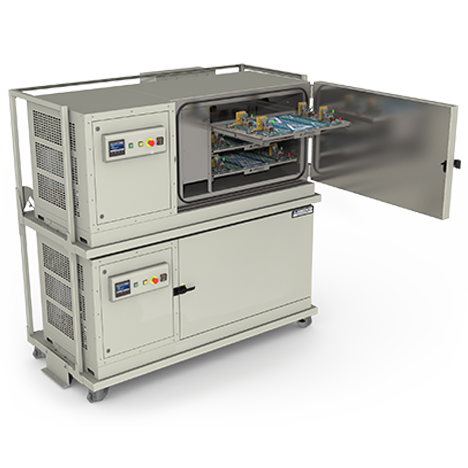
Our battery testing fixtures seamlessly integrate within our battery safety chambers. Rated up to EUCAR Hazard level 7, our battery test chambers keep in mind operator safety. They are designed first to prevent and then mitigate in case of a battery thermal event.

Read Industry Spotlights
RELEVANT ENVIRONMENTAL TEST CHAMBERS
BATTERY TEST CHAMBER
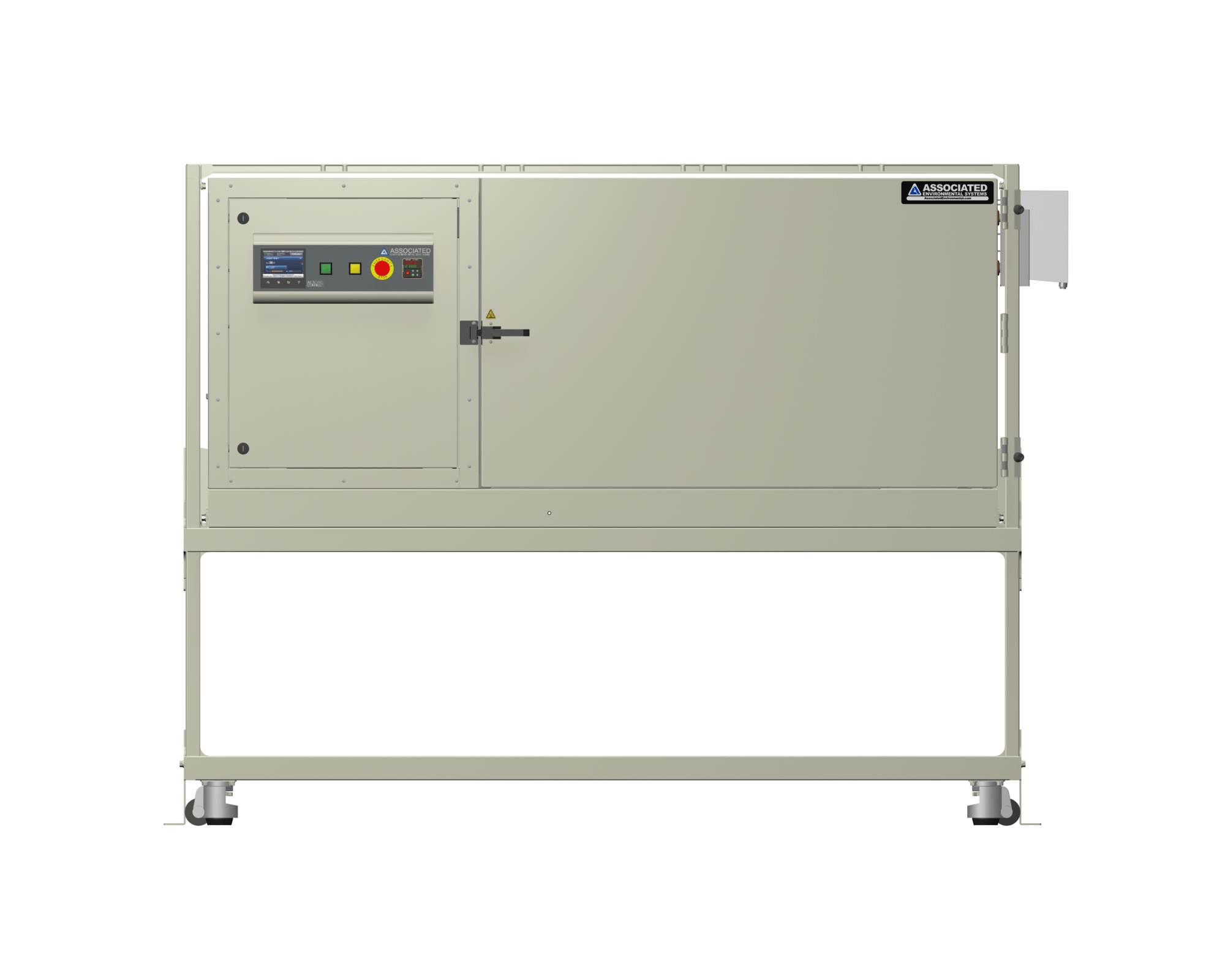
Conduct battery testing with safety features up to EUCAR Level 7 testing.
Double stack options are available
Available Volumes: 8 and 10 cu ft.
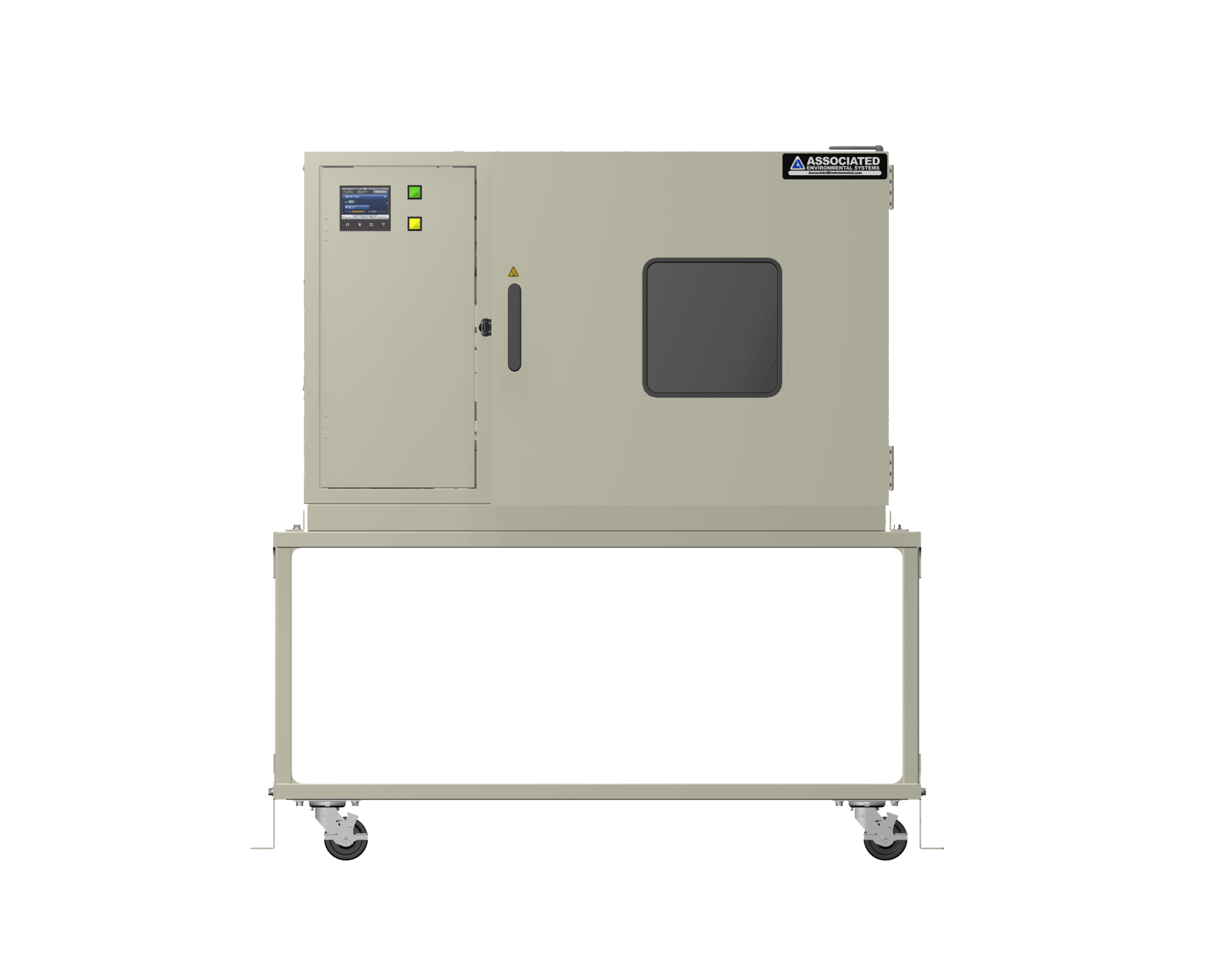
TEMPERATURE & HUMIDITY CHAMBER
Conduct temperature and humidity cycling testing.
Benchtop, stackable, and walk-in room options
Available Volumes: 2, 8, 10, 13 cu ft. Custom volumes available for walk in rooms.
THERMAL SHOCK
Two-zone thermal shock chamber with a pneumatically controlled vertical transfer basket for rapid product movement. LN2 cooled or mechanical cooled available.
Available Volumes: 2 , and 8 cu ft.
SALT SPRAY
The MX series creates a controlled corrosive environment without introducing outside contaminants.
Available Volumes: 4, 8 and 16 cu ft.

Frequently Asked Questions
Have Question? We are here to help
What are automotive test chambers used for?
Automotive test chambers are used to prove a part will survive the environmental conditions it is rated for before it reaches production. They compress a service life of heat, cold, moisture, and road salt into a test that runs in days or weeks, which is how a supplier verifies a lifespan warranty without waiting one out.
What automotive components can be tested in an environmental test chamber?
An environmental test chamber will test almost any automotive component that has to work in the weather, including seat belts, airbags, ECUs, sensors, and connectors. Larger chambers take assembled modules like instrument panels and battery packs. What limits you is usually workspace volume and the power the part draws while it runs.
When do you need a walk-in or drive-in automotive test chamber?
You need a walk-in or drive-in automotive test chamber once the part under test is too large for a benchtop or reach-in unit. Walk-in rooms and drive-in chambers also let you test whole systems together rather than one component at a time, and the larger sizes will hold entire vehicles. See our walk-in chambers for panel, structural, and field-built options.
How are environmental test chambers used for EV battery testing?
Environmental test chambers are used in EV battery testing to hold cells, modules, and complete battery systems at a controlled temperature while a cycler charges and discharges them. That is how you measure capacity and degradation at the temperatures a vehicle actually sees. Because a cell under abuse can fail energetically, the chamber also has to contain that event, which is why our battery test chambers are rated to EUCAR Hazard level 7.
How confident do you feel with where the company is going?
We will begin in this chapter by dealing with some general quantum mechanical ideas. Some of the statements will be quite precise, others only partially precise. It will be hard to tell you as we go along which is which, but by the time you have finished the rest of the book, you will understand in looking back which parts hold up and which parts were only explained roughly.
What automotive testing standards can environmental test chambers support?
Environmental test chambers support the automotive testing standards that specify temperature, humidity, thermal shock, and corrosion exposure, including ISO 16750-4, IEC 60068, SAE J1455, and UL 2054. A chamber meets one of these by holding the specified range, ramp rate, and uniformity for the full duration of the profile. We will confirm a specific clause against your test plan before you order.
How do I choose the right automotive test chamber for my application?
Choosing the right automotive test chamber comes down to four things. You need the conditions your standard calls for, the workspace volume your part needs, the heat it gives off while powered, and the ramp rate between setpoints. Development teams that size on volume alone often find the chamber cannot hold a setpoint against a live load. Vehicle testing chambers raise a fifth question, since the room has to clear the vehicle and the people working around it.